Spain's Next Great Eclipse: Looking Beyond Málaga's Lunar Gaze to 2026
The celestial ballet above Spain's stunning landscapes is always a source of wonder, from meteor showers illuminating summer nights to the rare spectacle of eclipses. While many in Málaga might recall or anticipate lunar events – such as the one referenced for September 7th in past discussions – the astronomical community is abuzz with preparations for a much rarer and more dramatic phenomenon: a total solar eclipse set to grace Spanish skies in 2026. This article will delve into the specifics of this upcoming total solar eclipse, clarify its path, and discuss how enthusiasts, even those wondering about the
fecha eclipse Málaga, can best experience this once-in-a-lifetime event.
For residents and visitors alike, understanding the distinction between lunar and solar eclipses is key to appreciating these awe-inspiring moments. Lunar eclipses, like those that have captivated audiences in Málaga before, occur when the Earth passes between the Moon and the Sun, casting a shadow on our lunar neighbor. These are often visible from entire nighttime hemispheres, offering a beautiful, though less intense, display. If you're keen to revisit the magic of such events, you might find
Málaga's Total Lunar Eclipse: Mark Your Calendar for September 7th and
Viewing Guide: Málaga's Total Lunar Eclipse on September 7th insightful. However, a total solar eclipse is an entirely different beast, a true cosmic alignment that transforms day into twilight and reveals the Sun's ethereal corona.
The Grand Alignment: August 12, 2026 – Spain's Date with Darkness
Mark your calendars:
August 12, 2026 is the pivotal date. On this Wednesday afternoon, Spain will become one of the prime locations on Earth to witness a total solar eclipse. This extraordinary event occurs when the Moon passes directly between the Sun and Earth, completely obscuring the face of the Sun. For a brief, breathtaking period, the sky will darken, temperatures may drop, and the Sun’s glorious corona—its outer atmosphere, usually hidden by the bright solar disk—will become visible. This truly is an event that transcends normal stargazing, offering a profound connection to the cosmos.
The path of totality, where the Moon's darkest shadow falls, will sweep across the northern and eastern parts of mainland Spain. Cities and regions that lie directly in this narrow band will experience several minutes of totality, a window of time where the Sun is completely hidden. While the official path is still being refined with maximum precision, early projections indicate that areas stretching from the north-western coast (Galicia, Asturias) down through parts of Castilla y León, La Rioja, Aragón, and even touching the Balearic Islands (Mallorca) could be within the prime viewing zone. This makes Spain an unparalleled destination for eclipse chasers from around the globe.
Decoding the "Fecha Eclipse Málaga": What to Expect on the Costa del Sol
Many residents and potential visitors to the Costa del Sol naturally inquire about the
fecha eclipse Málaga, hoping to witness the full glory of the 2026 total solar eclipse from their beloved city. It's crucial to clarify that while Spain is indeed experiencing a total solar eclipse, Málaga will unfortunately *not* be in the path of totality. The shadow will pass well to the north of the city.
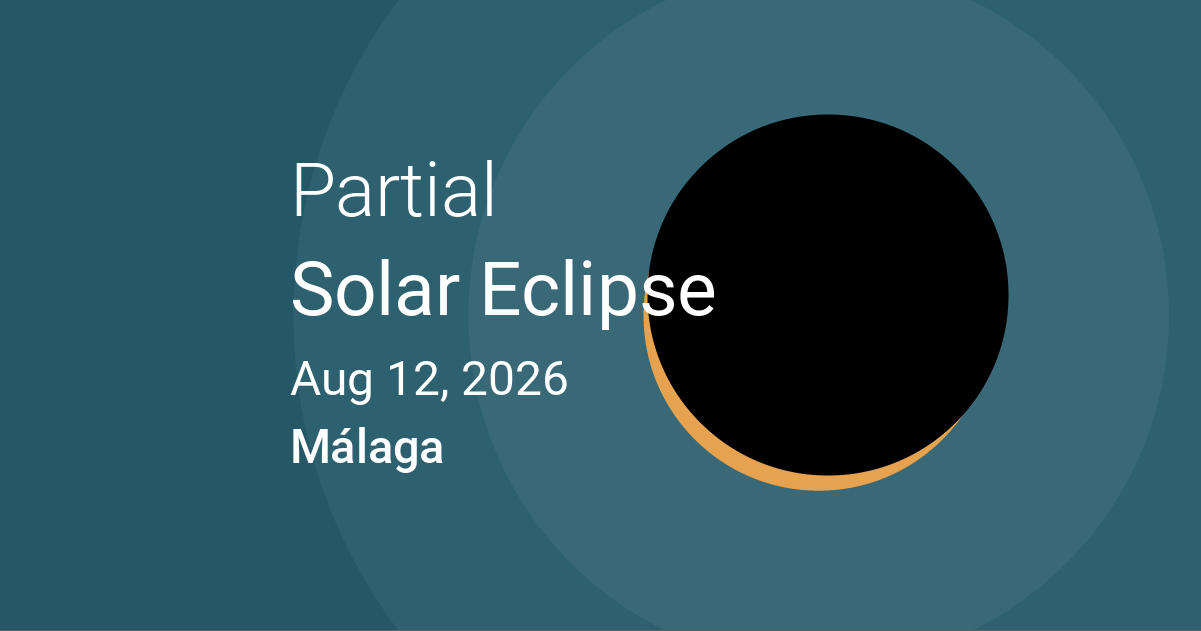
However, this doesn't mean Málaga will miss out entirely! On August 12, 2026, Málaga will experience a very significant *partial* solar eclipse. A substantial portion of the Sun will still be obscured by the Moon, creating a noticeable dimming of daylight and an intriguing crescent shape in the sky (when viewed safely). For those in Málaga, this will still be a remarkable astronomical event, a chance to witness the Moon taking a sizable bite out of the Sun.
For dedicated eclipse chasers seeking the full, immersive experience of totality, Málaga can serve as an excellent base for travel. Its well-connected airport, extensive accommodation options, and vibrant atmosphere make it an ideal starting point for a road trip north to the path of totality. Planning ahead for accommodation and travel within Spain is paramount, as areas within the eclipse path will undoubtedly see a massive influx of tourists.
Essential Preparations and Safety for Viewing the 2026 Solar Eclipse
Whether you're planning to stay in Málaga for the partial eclipse or venture north for totality, safety is paramount when viewing any solar eclipse. Looking directly at the Sun, even when it is partially obscured, can cause permanent eye damage or blindness.
Here are critical safety guidelines and preparation tips:
- Certified Solar Eclipse Glasses: The only safe way to look directly at the partially eclipsed or uneclipsed Sun is through special-purpose solar filters, such as "eclipse glasses" or handheld solar viewers. Ensure they are ISO 12312-2 international safety standard certified. Regular sunglasses are NOT safe.
- Telescopes and Binoculars: If using optical instruments, they *must* be fitted with certified solar filters over their front lenses. Never look through an unfiltered telescope or binoculars at the Sun.
- Pinhole Projectors: A simple and safe way to view the eclipse indirectly is by making a pinhole projector. This projects an image of the Sun onto a surface.
- Photography: If you plan to photograph the eclipse, your camera lens also needs a proper solar filter.
- Plan Your Journey: If traveling to the path of totality, book flights, accommodation, and rental cars far in advance. Roads leading into and out of prime viewing areas will likely experience significant congestion on eclipse day.
- Pack Essentials: Bring water, snacks, sunscreen, hats, and chairs, especially if you plan to be in an open viewing area for an extended period.
- Weather Contingency: While August in Spain is generally sunny, be prepared for potential cloud cover. Have a backup plan or flexibility to move to a clearer spot if possible.
During totality itself (and *only* during totality), it is safe to remove your eclipse glasses and view the Sun's corona directly. However, the moment the first bright sliver of the Sun reappears, glasses must be immediately put back on. This period of totality is fleeting, so be mindful of the transition.
Beyond the Darkness: Embracing Spain's Astronomical Future
The 2026 total solar eclipse offers a unique opportunity for Spain, not just as a host nation for a spectacular astronomical event, but also as a chance to foster scientific curiosity and tourism. The country's generally clear skies, diverse landscapes, and robust infrastructure make it an ideal setting for such a phenomenon. For those who miss the 2026 event, another total solar eclipse will cross Spain in 2027, offering a rare second chance in quick succession. This makes Spain a truly exceptional destination for eclipse chasers for years to come.
Whether you're pondering the
fecha eclipse Málaga for local observations or planning an epic journey to experience totality, the upcoming 2026 solar eclipse promises to be an unforgettable chapter in Spain's rich history. It’s a moment to pause, look up (safely!), and marvel at the incredible mechanics of our solar system, uniting communities under the temporary shadow of our cosmic neighbor. Start planning your adventure now to secure your spot for this celestial masterpiece.